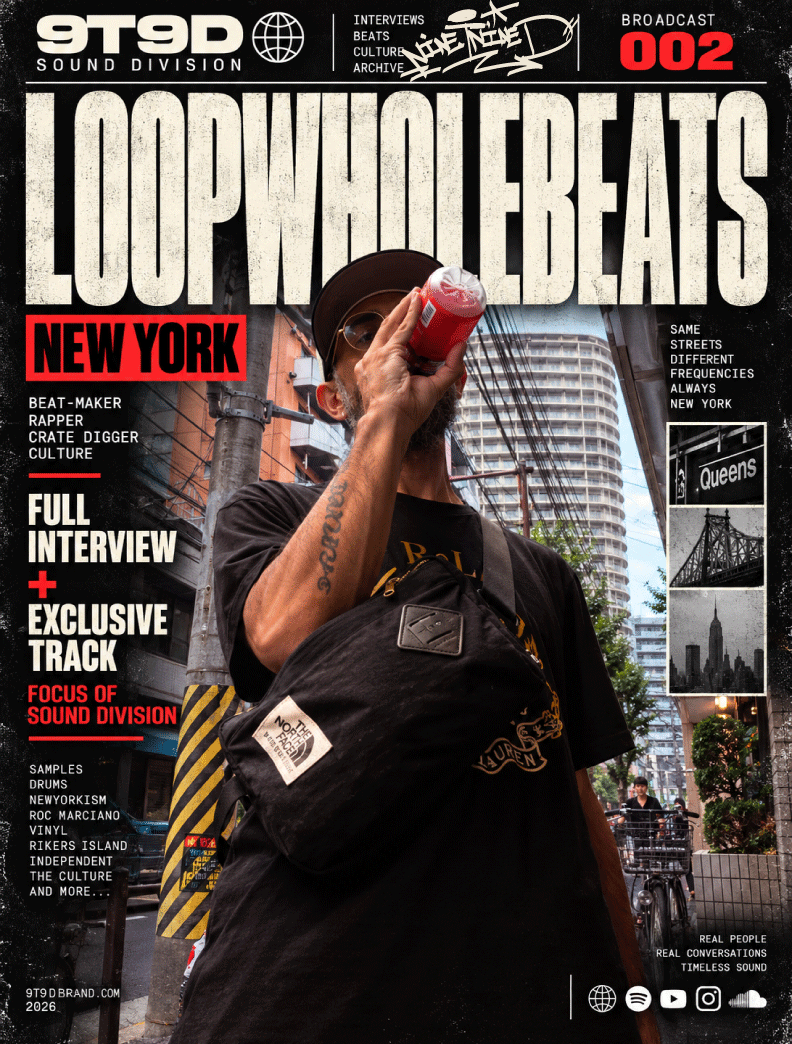
Focus of Sound Division
Loopwhole Beats
Beats, records, Queens, Rikers Island, dirty mixes, long loops, E-Mu machines, independence and a lifetime spent chasing music that actually feels like something.
The Conversation
Loopwhole Beats has spent decades treating records like maps. Queens, Bushwick, Roosevelt Avenue, Atlantic Avenue and Rikers Island all appear throughout a catalog built from memory, struggle, drums, long loops and an uncompromising attachment to the sound that shaped him.
Follow / Listen / Support
Dig Deeper
Follow the work, hear the records and support the music directly.
For people just discovering you, who is Loopwhole Beats?
A hardworking beat-maker, and part-time rapper.
Where in New York shaped your ear the most?
I think most of the stuff I gravitated to as a teen was out of Queens. Particularly QB. I loved the Brooklyn gritty stuff, Harlem fly shit, BX shit. But Queens had a fly, smooth, melodic way. And a lot of those records stuck with me.
When did you first start making beats, and what was the first setup?
I first started in 1997/98 on an MPC 2000. One of the close homies who was another big hip-hop head got it and we were just amazed. From then I moved on to the MPC 4000, and soon after that I started getting into more high-end E-Mu Systems products.
What was the first record that made you think, “I need to sample this”?
I have no clue. It’s been a long time since then. Especially in those early years, I cared not about the samples, but the records.
I would sit and listen to anything looking for a break or a loop. I just wanted a plethora of wax to search in.
Dollar records, or free records at that point. So I would just put any records on and see what was there. It wasn’t until way later that I had become more selective.
Do you consider yourself producer-first, rapper-first, or just an overall hip-hop craftsman?
I just have love for hip-hop culture, and I have worn many hats in this game. I think it pays to be flexible and know your craft.
I think I’m a producer before all. Even though I started rapping in 1992/93.
What does “Newyorkism” mean to you?
Well, it’s my beats, with other mostly New York rap. There’s a few guys that might not rep NYC, but still bring that same energy.
What should someone play first if they’ve never heard your work?
I would suggest “2 Cities” ft. Roc Marciano. Seems to be the favorite of the people. It’s a good indicator of what type of time I’m on.
You’ve got tracks named after places like Rikers Island, Bushwick, Queens Blvd., Roosevelt Ave., Atlantic Ave., and Broadway. Are those maps, memories, or moods?
Those are all names of streets or neighborhoods in New York where I was around digging records, and living daily life. Definitely memories when I replay those songs.
Newyorkism had Sadat X, Shabaam Sahdeeq, Miilkbone, Lewis Parker, Grand Daddy I.U., Eastkoast and J-Love. Who surprised you most in the studio?
GRAND DADDY IU! Yo. That was crazy. I was like yoooo this legendary here.
We went to the store and bought a bottle of Henny for me and Remy for him. We made it happen.
That was the first time I was like, “Yo, this is a guy I seen on TV as a kid.” Rest in peace IU.
“Bushwick Pt. II” with Shabaam Sahdeeq and Miilkbone was marked “only available on vinyl.” Why keep certain things vinyl-only?
I think at that time there was a big push in digital music over records. And I think that term was used for marketing. To let people know the type of shit we were on.
ONLY IN AMERIKKKA with Eastkoast got Bandcamp Album of the Day. Did that change anything for you?
No. The reality is I ended up incarcerated on Rikers Island, in the final stages of that record being pressed.
We already had the test pressings back and were just waiting on the boxes of vinyl to arrive. About a month before they arrived I was gone, and stayed in jail for the next five years.
Thankfully, all the pre-orders were still shipped to people who purchased them. But I still had bad management at that time. And the manager ran off with the money to Colombia.
I was just happy the people who bought it received it.
That record is kind of the ugly duckling of my catalog because of all these issues with it. I don’t really even count that one to be honest. It’s more about NEWYORKISM.
Funny thing about that record, I’ve never in my lifetime actually had a physical copy of it. I really want nothing to do with it at this point.
Do you start with drums, bassline, sample, or title?
Usually drums. But I always have the whole concept of what I will use already.
I think most times it will help you lay everything out mathematically if you lay drums first. It sets a great foundation.
How long does it usually take you to know a beat is worth keeping?
Right away! If it doesn’t sound right I’ll move on.
Likewise, if it sounds good, I might take days picking apart one segment of the sample.
I know when the record is on the turntable, what it could be.
What makes a loop hypnotic instead of boring?
Very hard to describe. But you know it when you feel it in your body.
I like to look for emotional movements in the music. Sad music mostly.
What’s your rule for chopping samples?
It’s all about loops for me. It’s gotta be a full piece of music.
I’m into long segments of music with variations of the same loop. That’s where you can really get busy in my opinion.
And then just break it up mathematically so it rides the drum grid.
What’s your favorite mistake that became part of your sound?
“First of all, ain’t no mistakes allowed!” lol nah.
A lot of people have issues with my mixing methods. Say it sounds too dirty. But that’s fine.
I make music for myself. Music that I want to listen to. So if other people like it, that means they are on the same wavelength.
How did the Roc Marciano connection happen for “Two Cities”?
That happened through my brother Grand Daddy IU.
He was an older rapper from the first generation of hip-hop. Being from Long Island, and being on one of the first big-time labels, Cold Chillin’ Records, he knew everyone.
I told him I wanted to do a joint with Roc. This was the years where Roc was pretty big on the underground, but nowhere near the status of today. He was on the cusp of greatness.
So he called him and we made it happen. Me and my managers at that point went to New Jersey to work with him.
Who is your dream artist to produce a full album for?
I’d say probably Guru, R.I.P., or maybe the current Roc Marci. But mostly Boldy James.
I think he’s the best right now honestly. In topics that I personally can relate to, I feel like he’s really having a great moment.
I love everything that he puts out. It’s fantastic.
What do newer producers misunderstand about the golden-era sound?
I feel like it’s cosplay almost. You can make a good RENDITION of it.
But if you were not there, absorbing that energy of America in the ’80s and ’90s, it’s hard to really be on target with that sound.
Does expensive gear matter, or is it all ears?
It definitely depends on what kind of sound you are looking for.
I think there’s a certain standard, and if you lack in the sampler area, you have to be more proficient with mixing. Vice versa.
It’s hard to say. Yes you can get a good sound out of lower-cost samplers, but NOTHING sounds like an E-Mu.
Why did you choose Bandcamp as a main home for your music?
I didn’t want to go through any labels.
At the time I first dropped NEWYORKISM, it was the best way to sell directly to customers.
I was trying to get a publishing deal through two labels over in Europe. Thankfully, that never materialized.
I’m very happy I self-published all of my work.
VISIT LOOPWHOLE BEATS ON BANDCAMP ↗What should fans understand about buying directly from independent producers?
I think they are directly funding these projects. It’s their project too!
Much respect to the people who support these record projects. Amazing.
What’s the best way for artists to approach you for beats?
Find me on IG, I write back. Or they could email me at loopnyc25@icloud.com .
What’s next for Loopwhole Beats?
Yo, I’m just over here in Japan. Finishing up my next album, and hopefully in the next 12 months I’ll be able to have another vinyl out.
That is the goal. I’m going to do my best.
What record would you want people to find in a crate 30 years from now with your name on it?
Probably NEWYORKISM II.
What does New York still sound like to you?
I think New York and the world in general had moved on from that kind of sound. It used to be very regional. Now people make music from all over.
Current New York sound, that you would hear in the streets, it’s not anything very individual.
It’s very homogeneous with other regions’ music. Nothing screams NYC like it once did.
If the SP-1200 could talk, what would it say about you?
Well, hopefully it can say I attempted to use it to its full ability!
What do you want Loopwhole Beats to represent when people look back at this era of underground hip-hop?
Honestly, I hope people can hear the authenticity in those records. It was very real for me.
Living in very poor neighborhoods of New York. No money. No hope. Only the hope to make some impressive music.
I hope people see me as real. Because I’m not fake at all.
Every single rhyme matters. I did all that. Not one lie told. Always keeping it real on wax.
A lot of those people made records at that time were rich kids. They had money for all the weed, clothes, the sneakers, the SP-1200s, fund all their own shit.
It was not like that for me. It was pure struggle.
What is one thing about your story that the music explains better than an interview ever could?
It’s sadness.
There is always something a bit sad in my music. But that’s life.
It’s not all roses. It’s not all bad, but sometimes people only promote the high life.
Life has ups and downs. We have to embrace both ends. The good with the bad.
Independent Music
Support The Records Directly.
Buying directly from independent artists puts support back into the next project, pressing and release.
Leave a Reply